Dynamic Vlan Assignment Microsoft Nps Windows
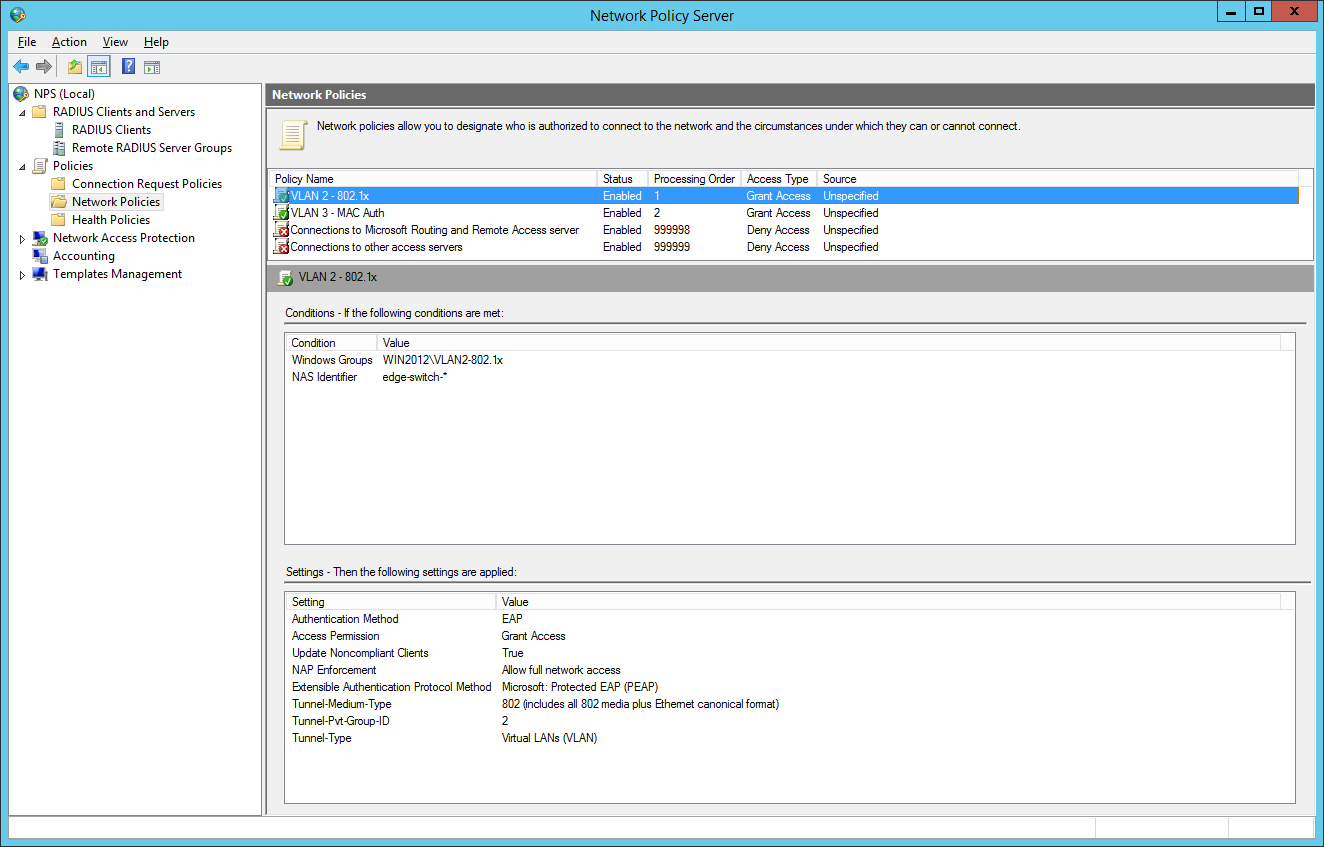
Hotfix The Microsoft Windows. An NPS server that is running Windows Server 2008. The protected dynamic volume on a Windows 7-based. Jul 13, 2017. Click here to see this product's warranty document. This document introduces the concept of dynamic VLAN assignment. The document describes how to configure the wireless LAN controller (WLC) and a RADIUS server to. Dynamic Vlan Assignment Microsoft Nps Radius. Netsh - Windows CMD - SS6. I have several questions about implementing dynamic VLAN assignment based on 802.1x authentication on 3com switches - I hope it is the right place to ask. Generally, unmanaged switches will not support Dynamic VLAN with NPS. Supplicant: Windows / Windows Phone / iOS / Android / etc.
MAB offers the following benefits on wired networks: • Visibility: MAB provides network visibility since the authentication process provides a way to link a device's IP address, MAC address, switch, and port. This visibility is useful for security audits, network forensics, network use statistics, and troubleshooting. • Identity-based services: MAB enables you to dynamically deliver customized services based on an endpoint's MAC address. For example, a device might be dynamically authorized for a specific VLAN or assigned a unique access list that grants appropriate access for that device. All the dynamic authorization techniques that work with IEEE 802.1X authentication will also work with MAB. • Access control at the edge: MAB acts at Layer 2, allowing you to control network access at the access edge.
Abklex: Lexikon von Abkuerzungen aus Informatik und Telekommunikation. Adobe Cc All Product X-force Keygen / Activator there.
• Fallback or standalone authentication: In a network that includes both devices that support and devices that do not support IEEE 802.1X, MAB can be deployed as a fallback, or complementary, mechanism to IEEE 802.1X. If the network does not have any IEEE 802.1X-capable devices, MAB can be deployed as a standalone authentication mechanism. • Device authentication: MAB can be used to authenticate devices that are not capable of IEEE 802.1X or that do not have a user. MAB enables visibility and security, but it also has limitations that your design must take into account or address: • MAC database: As a prerequisite for MAB, you must have a preexisting database of MAC addresses of the devices that are allowed on the network. Creating and maintaining an up-to-date MAC address database is one of the primary challenges of deploying MAB.
• Delay: When used as a fallback mechanism to IEEE 802.1X, MAB waits for IEEE 802.1X to time out before validating the MAC address. During the timeout period, no network access is provided by default. Delays in network access can negatively affect device functions and the user experience. A mitigation technique is required to reduce the impact of this delay. • No user authentication: MAB can be used to authenticate only devices, not users.
Different users logged into the same device will have the same network access. • Strength of authentication: Unlike IEEE 802.1X, MAB is not a strong authentication method. MAB can be defeated by spoofing the MAC address of a valid device. 2.2 Functional Overview 2.2.1 What Is MAB? MAC address authentication itself is not a new idea. An early precursor to MAB is the Cisco ® VLAN Management Policy Server (VMPS) architecture. With VMPS, you create a text file of MAC addresses and the VLANs to which they belong.
That file gets loaded into the VMPS server switch using the Trivial File Transfer Protocol (TFTP). All other switches then check with the VMPS server switch to determine to which VLAN those MAC addresses belong. MAB represents a natural evolution of VMPS. Instead of storing MAC addresses on a VMPS server switch, MAB validates MAB addresses that are stored on a centralized (and thus more easily managed) repository and that can be queried using the standard RADIUS protocol. 2.2.1.1 High-Level Functional Sequence. From the switch's perspective, the authentication session begins when the switch detects link up on a port.
The switch will initiate authentication by sending an Extensible Authentication Protocol (EAP) Request-Identity message to the endpoint. If the switch does not receive a response, the switch will retransmit the request at periodic intervals. If no response is received after the maximum number of retries, the switch will let IEEE 802.1X time out and proceed to MAB. 2.2.3 MAC Address Learning.
By default, the Access-Request message is a Password Authentication Protocol (PAP) authentication request, The request includes the source MAC address in three attributes: Attribute 1 (Username), Attribute 2 (Password), and Attribute 31 (Calling-Station-Id). Although the MAC address is the same in each attribute, the format of the address differs. This feature is important because different RADIUS servers may use different attributes to validate the MAC address. Some RADIUS servers may look at only Attribute 31 (Calling-Station-Id), while others will actually verify the username and password in Attributes 1 and 2. Because MAB uses the MAC address as a username and password, you should make sure that the RADIUS server can differentiate MAB requests from other types of requests for network access. This precaution will prevent other clients from attempting to use a MAC address as a valid credential. Cisco switches uniquely identify MAB requests by setting Attribute 6 (Service-Type) to 10 (Call-Check) in a MAB Access-Request message.